
Top Adaptive PE Activities for Primary Schools
The demand for adaptive PE and inclusive physical education is growing rapidly. With increasing awareness of SEN and a stronger focus on inclusion in schools and communities, teachers are actively searching for practical ways to support PE for all pupils.
Adaptive PE ensures every child, regardless of physical, sensory, cognitive, or emotional needs, can enjoy, access, and benefit from physical education. Below are some inclusive, engaging, and adaptable ideas designed specifically for primary schools.
Fun and Inclusive Adaptive Activities
SEN PE activities should prioritise enjoyment, confidence and participation. When children feel safe and successful, they are far more likely to engage with their PE lessons.
Target Games
Target games are a great fit for adaptive Physical Education because they can be easily modified to meet a wide range of abilities while keeping everyone engaged and successful. By adjusting equipment size, distance, targets, or rules, students of all skill levels can participate in a meaningful way. For example:
Set up:
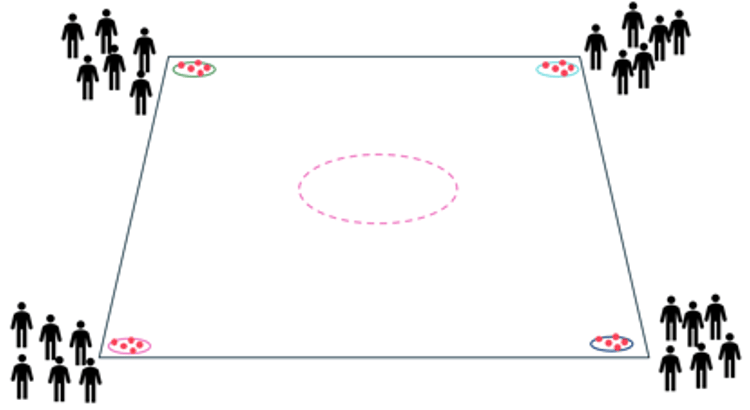
· Split the class into four teams, each in the corner of a grid (see diagram).
· Each team needs five balls each.
· A hoop or square made of cones should be placed in the middle of the grid.
How to play:
· The aim of the game is to be the first team to get all five balls into the zone in the middle of the grid.
· This is done by children taking turns in their team to roll their ball underarm, aiming for it to stop in the middle zone.
· If successful, the next child rolls the next ball.
· If unsuccessful, the child chases the ball they rolled and brings it back to their team for the next person to roll.
· Once a ball is in the middle zone, it stays there. If knocked out by accident, it can be put back in.
Adaptations
Easier: Move closer to the target
Extension: Change the types of balls e.g. tennis balls, dodgeballs, foam balls etc.
Sensory Circuits
Sensory circuits are structured sequences of physical activities designed to help children regulate their sensory systems and prepare their bodies and minds for learning. Typically comprising alerting, organising, and calming movements, these circuits are especially effective in adaptive PE. They support pupils with SEN by improving focus, coordination, and emotional regulation, while reducing anxiety and sensory overload.
Parachute Play
Parachute games encourage teamwork and sensory engagement and are very easy to adapt for all learners. Below is a selection of engaging parachute games.
Set Up: Begin by spacing the children around the parachute. When children are in position, practise making waves with the parachute. Ask children to practice making small, medium, and large waves by varying the up-and-down movement of their arms.
How to play:
Game 1 – Place a ball on the parachute. Work together to roll it around the edge or try to land it in the middle hole (if your parachute has one).
Game 2 – All children squat down, holding onto the parachute. On the teacher’s count of three, all children stand up and raise their arms above their head as quickly as possible. Hold up in the air (this can form the space for other games). Repeat several times until it is being raised at the same time on all sides.
Game 3 - Lift the parachute (as in Game 2). Call two names; those children run under the parachute and swap places. Remind them to avoid bumping into each other. Extension: Count how many swaps can be made before the parachute falls.
Game 4 - Assign colours from the parachute to children. When you call a colour, those pupils swap places by running under the parachute.
Game 5 - Place lots of beanbags and soft balls on top of the parachute. Children can make waves and watch the balls/beanbags bounce around like popcorn. How long can they keep all the popcorn on the parachute?
To find the best place to get a parachute set for your school, check out our blog here for the best suppliers for primary schools.
Engaging Lesson Ideas for Adaptive PE
Strong adaptive PE lesson plans combine structure with flexibility. Clear routines help pupils feel secure, while adaptable tasks allow teachers to meet individual needs.
Empty the Tank
Set up:
· Split the class into pairs.
· Split the beanbags between the two teams (minimum one beanbag each).
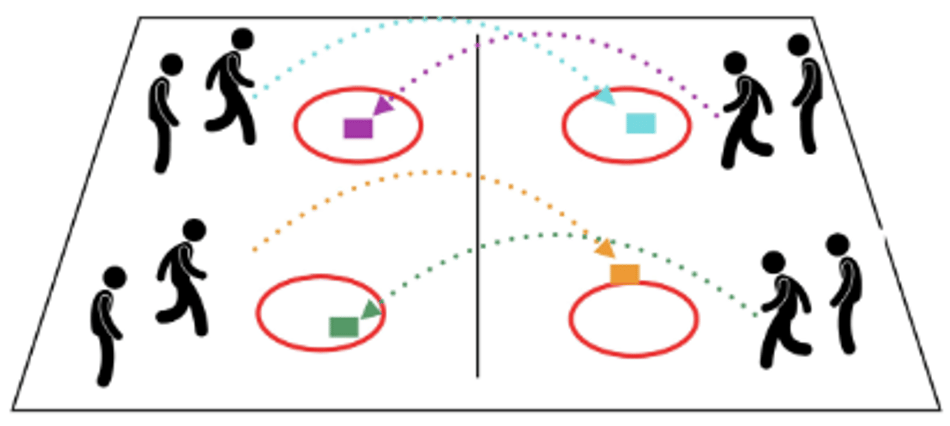
· The aim is to throw your beanbags into the opposition's hoop whilst the other pair tries to toss beanbags into your hoop.
How to play:
· The teams must throw from behind their hoop (see diagram).
· When beanbags land in your hoop, you need to get them out and throw them back into your opponent’s hoop.
· Time the game - when the time is up, the pair with the fewest beanbags wins.
· Swap opponents and repeat the game.
Adaptations
- Move targets closer or farther away.
- Allow rolling instead of throwing.
- Use larger/lighter balls.
- Provide seated throwing options.
Team Bridge Builder
Set up:
· Mark a start and finish line.
· Place mats, hoops, or floor spots at the starting area.
· Ensure the distance between start and finish suits the group’s ability level.
- The goal is to move from start to finish without touching the “water” (floor outside the equipment).
How to Play:
- Divide pupils into small groups.
- Give each team several mats or hoops as bridge pieces.
- Pupils must work together to place and move pieces forward as a team.
- Celebrate teamwork and communication rather than speed.
Adaptations
- Allow walking, crawling, or assisted movement.
- Reduce the distance.
- Allow extra bridge pieces for easier success.
- Provide adult support for balance.
Promoting Participation and Supporting Every Child
Inclusive PE is not about making everyone do the same thing. It’s about ensuring every child feels they belong and that they can participate in physical education with their peers.
Positive reinforcement is an important part of SEN PE. Celebrating effort, persistence, teamwork, and personal progress, rather than just outcomes, builds confidence, particularly for pupils with SEN.
Clear instructions further support inclusion, with simple language, demonstrations, and visual prompts helping pupils better understand expectations, especially those who benefit more from seeing instructions than only hearing them.
Tailoring Activities and Inclusive Equipment
The right adaptations and inclusive equipment can completely transform a PE lesson for pupils by removing barriers and increasing confidence. Simple changes such as using lighter balls, textured equipment, larger targets, or adjustable hoops can make activities far more accessible and enjoyable.
Flexibility in rules is equally important. Adjusting time limits, distances, or scoring systems; allowing rolling instead of throwing; or removing competitive elements altogether helps ensure that all pupils can participate meaningfully. In addition, offering one-to-one or small-group options provides extra support for pupils who may benefit from adult guidance or a quieter setting before joining whole-class activities.
Adaptive PE at The PE Hub
At The PE Hub, we are committed to ensuring that every child can access and enjoy high-quality Physical Education. We carefully design our activities so they can be easily adapted using the STEP principle to provide the right level of challenge and support. This might include adjusting the playing area size, simplifying instructions, using different types of balls or visual aids, or adjusting groupings to encourage confidence and success. We also provide further information on implementing sensory circuits to help pupils regulate, focus, and prepare for learning. By embedding flexibility and inclusivity into every lesson, we help teachers create an environment where all children can move, achieve, and thrive. For more guidance, please check out our blog on using the STEP principle in primary PE.