KS1 Wellbeing Lesson 1
Lesson Summary
Learning Intentions
- Connect – Work with a partner by communicating clearly to complete tasks together
- Acquire a new skill – Learn new ways to move and control a ball
- Mindfulness – Practise narrowing your focus to help clear your mind
Success Criteria
- Connect – I can work with a partner and communicate clearly to complete a task
- Acquire a new skill – I can move the ball in different ways and try new tricks
- Mindfulness – I can focus my attention to help clear and calm my mind
We are Learning...
to improve our throwing and catching by playing different games
Curriculum Links
NC Pupils will engage in cooperative activities while developing basic movement skills such as throwing and catching, and improving their coordination
L Communicate with partner as part of a cooperative pair
N Count in multiples of 2
Equipment
- Cones
- Range of different balls/beanbags
- Scarves for throwing
Key Questions
- Why is it important to watch the object carefully when catching?
- How can using different hands improve your coordination?
- How did you show your partner you were ready to receive?
Pairs Sending and receiving
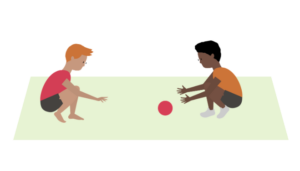
Teaching Points - Connection activity
✔️ Sending and receiving with partner
- Show your partner you are ready with your hands to receive
- Make eye contact and tell them
- Send your beanbag or ball accurately
- Make sure you use enough power for the beanbag/ball to reach
- Swing back with your arm and point to the target
- Have hands ready to receive the ball/beanbag
Lesson Content
Physically Active
Purpose: This activity helps pupils develop hand-eye and foot-eye coordination, control, balance, and concentration while handling equipment in different ways.
Each pupil should have:
- 1 ball
- 1 beanbag
- 1 button cone
Pupils will practise four different skill challenges: (See “Ball Skills” video for demonstrations of each activity.)
- Figure of 8 weaving the ball through the legs
- Throwing the ball in the air and catching it
- Lifting a beanbag with the foot and catching it
- Circling the ball around the legs while in a tabletop position
How to play:
- Demonstrate each skill clearly before pupils practise independently
- Spend a few minutes exploring each challenge before introducing the next
- Once pupils are familiar with the skills, allow them to move freely around the space carrying or controlling their ball or beanbag – use different ways of travelling such as jog, side step etc.
On the teacher’s signal:
- Pupils stop immediately
- Perform one of the skills learned e.g figure of 8
Remind pupils to: Keep equipment under control at all times. Focus on smooth movements rather than speed. Alternate hands or feet where possible.
Extension: Link two or more skills together into a short sequence.
Look for: Control of the ball or beanbag throughout. Coordination between hands, feet and object. Balance and body control during activities. Concentration and persistence when practising skills. Smooth, controlled movements rather than rushing.
Connection Activity - Pass the Parcel
Purpose: This activity helps pupils develop throwing, catching, coordination, and spatial awareness while moving around others, creating connections through communication.
How to play: Give half of the class a small piece of equipment such as:
- Tennis ball (harder) / Beanbag (Easier)/ Scarf (Easiest)
- All pupils move freely around the space, avoiding others
On the teacher’s signal (whistle or shout):
- Pupils with equipment quickly find a partner who does not have one
- Pairs stand about 1 metre apart
- The pupil with the equipment throws it once to their partner, who attempts to catch it
After the catch:
- The catcher becomes the new carrier and continues moving with the equipment
- The thrower moves away without equipment
Extension: Increase the number of throws before changing carrier (use an odd number so the object changes hands). Introduce different sizes or types of equipment.
Look for: Communication and readiness with partners through eye contact, gesture and verbal means. Controlled throws towards a partner. Watch the object carefully when catching. Attempts to catch the item. Increased control and accuracy during the activity.
New Skill Activity - Pairs Throwing (See supporting video for demonstration)
Set up
- Pupils work in pairs of similar ability, standing about 1 metre apart, facing each other
- Each pair has two beanbags and two tennis balls
How to play: Take the pupils through the progressions in the “Pairs throwing” video
- Sliding one beanbag, receiving and sending with different hands
- Sliding two beanbags
- Rolling one ball, receiving and sending with different hands
- Rolling two balls
- Throwing one beanbag, receiving and sending with different hands
- Throwing two beanbags
Not all pairs will progress at the same rate; it is okay to move some onto the next stage while others spend more time practising.
Look for: Accurate sending. Watching the object closely when receiving. Positive communication with partners. Persevering with trickier tasks.
Mindfulness Activity - Cyclical Breathing
Purpose: This activity helps pupils develop breathing control, relaxation, and focus. It encourages children to become more aware of how their breathing affects their body and helps them feel calm and settled.
How to play: Ask pupils to find a quiet space and lie comfortably on their backs. Each pupil places a beanbag on their chest or upper tummy.
Explain that this is a calm, quiet activity where everyone should try to relax and focus on their breathing.
Guide pupils through a slow breathing cycle using a count of four:
- Breathe in slowly for 4 counts
- Hold the breath for 4 counts
- Breathe out slowly for 4 counts
Encourage pupils to watch the beanbag:
- Rising as they breathe in
- Staying still as they hold their breath
- Falling as they breathe out
Repeat the cycle several times, helping pupils slow their breathing and remain relaxed.
Look for: Slow, controlled breathing. Beanbag rising and falling steadily. Calm and relaxed body position. Quiet focus and concentration. Ability to follow the breathing rhythm consistently.