KS2 Wellbeing Lesson 1
Lesson Summary
Learning Intentions
- Connect – Work cooperatively with a partner by communicating clearly and effectively
- Acquire a new skill – Learn and practise the key steps involved in juggling
- Mindfulness – Develop the ability to narrow your focus to improve mental clarity and concentration
Success Criteria
- Connect – I can communicate clearly with my partner to complete cooperative tasks
- Acquire a new skill – I can follow and attempt the key steps to begin learning how to juggle
- Mindfulness – I can focus my attention to help clear and calm my mind
We are Learning...
the steps to juggle three balls.
Curriculum Links
NCPupils will use throwing and catching both on their own and with others, enjoy working together through communication and collaboration, and reflect on their own success
L Explain one of the steps in juggling
N Count in multiples during activities such as catches, throws, or steps
Equipment
- Cones
- Beanbags
- Tennis Balls
- Juggling Balls
- Scarves
Key Questions
- How did working with a partner in the throwing activity help prepare you for learning to juggle?
- In what ways do you use hand-eye coordination when juggling?
- How might regular mindful breathing help you in other parts of your day, both in and out of school?
Pairs Throwing
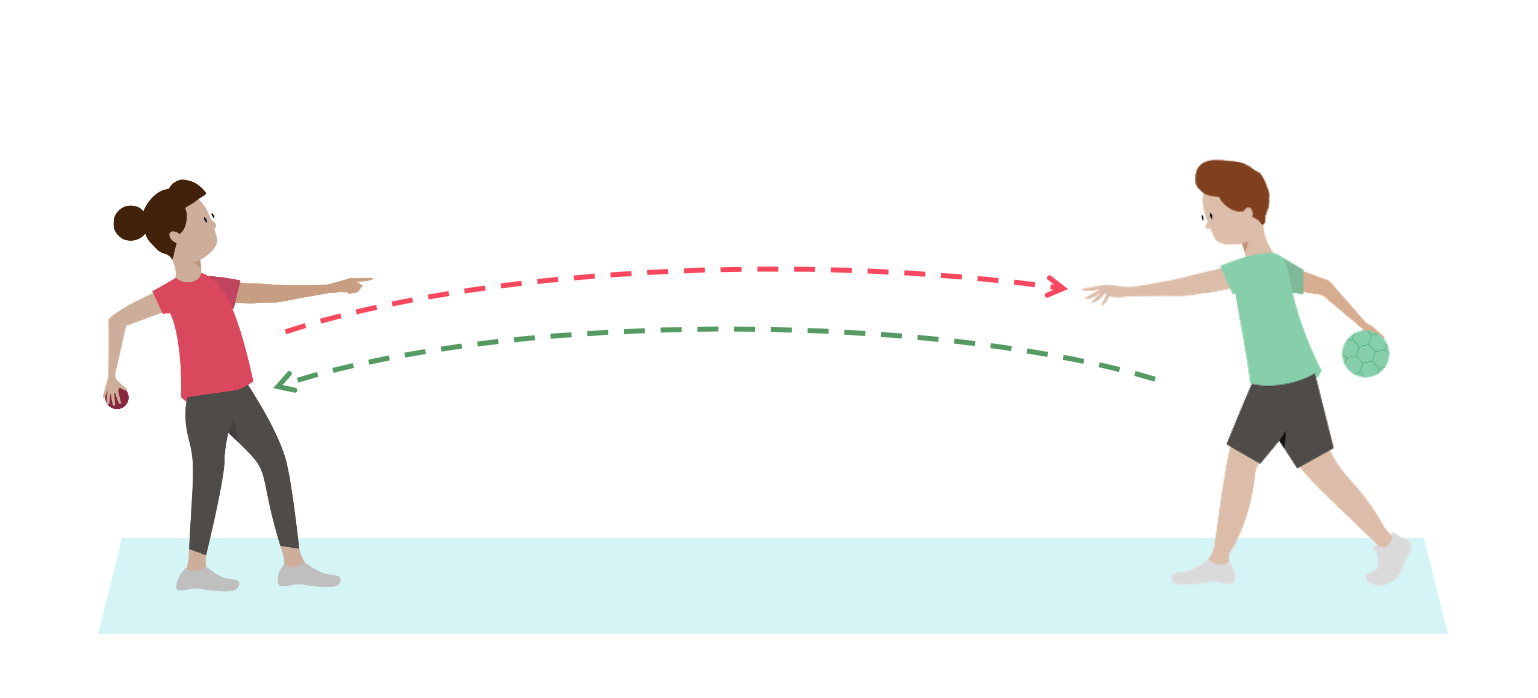
Teaching Points
Pairs Throwing Activity
- Use an underarm throw so the ball follows a smooth arc toward your partner.
- Focus your eyes on the ball you are about to catch, not the one you’re throwing.
- Communicate with your partner using a clear countdown (e.g. “3, 2, 1, throw”) to throw and catch at the same time.
Lesson Content
Physically Active - Kick and Switch
Objective: To eliminate all of the opposing team’s runners by turning them into chasers.
Set-Up:
- Use a playing area with two end zones and one foam ball
- Split the class into two teams using bibs to distinguish them.
- Each team lines up along their baseline.
- Select one player from each team to begin as the “chasers” in the middle area.
How to Play:
- One team starts by rolling the ball towards the opposite team.
- A player from that team kicks the rolling ball into the playing area.
- As soon as the ball is kicked, both teams attempt to run and switch to the opposite baseline safely.
- The chasers in the middle try to eliminate runners by hitting them below the waist with the ball.
- If a player is eliminated, they become a chaser for the next round.
- Teams continue taking turns rolling the ball in.
Ways to Get Out:
- If the kicked ball is caught before it bounces, the kicker becomes a chaser.
- If a player is hit below the waist by the ball while running, they become a chaser.
- If a runner touches a ball at any time, they are out and become a chaser.]
Rules:
- Chasers may pass the ball to teammates.
- Chasers can work together to trap runners using positioning only.
- No pushing, grabbing, or stealing the ball from others.
- All players must stay on their feet.
- Runners cannot throw, kick, or carry the ball once play begins.
Look for: Quick reactions and changes of direction. Effective kicking into space. Awareness of where chasers are positioned. Team communication and decision-making. Dodging and movement skills while running. Enjoying playing and being active.
Connection Activity - Partner Reaction Catch
Set-Up:
Set the children up in pairs, standing approximately 1 metre apart and facing each other. Each child should have a small object that can be thrown and caught with one hand, such as a beanbag or tennis ball.
How to play:
- Both children begin holding their object in their right hand by their side.
- On the teacher’s signal, both children perform an underarm throw at the same time towards their partner.
- Each child attempts to catch their partner’s object using their left hand.
- Repeat the activity, starting with the object in the left hand and catching with the right.
- Continue alternating hands to develop coordination on both sides of the body.
- Encourage children to establish a smooth rhythm of throwing and catching without stopping.
Easier: Begin with two-handed catches to help children understand the timing and movement pattern. Reduce the throwing distance if children are struggling with accuracy or catching. Sue scarves.
Harder: Increase the distance between partners. Progress from beanbags to tennis balls for a greater challenge.
Extension:
- Encourage continuous throwing and catching without pausing.
- Challenge pairs to maintain a steady rhythm for 30 seconds or more.
- Introduce movement by asking children to side-step slowly while throwing and catching.
Look for: Eyes focused on the object throughout the catch. Soft hands when receiving the object. Accurate underarm throws towards the partner’s hand. Good timing and coordination between throw and catch. Hands ready to receive. On toes, ready to move to catch if needed.
Learn a new skill - Juggling
Set up: Each child will need three small balls (Harder), Beanbags (Easier). Explain that learning to juggle takes practice, patience, and persistence, and that it’s normal for it to feel challenging at first. Take time with each step and allow plenty of repetition before moving on.
Use the handout and the supporting video to lead the children, or, for those able, have them read it to guide them through the steps.
Easier: Any pupil who is not able to achieve step 2, consider giving them two scarves. This will allow them time to create the arc and pass the second scarf to the free hand.
Reflection: Talk with the class about how learning to juggle shows the value of perseverance, focus, and staying calm when learning something new. Celebrate small progress steps.
Mindfulness - Cyclical Breathing
Purpose: This activity helps pupils develop breathing control, relaxation, and focus. It encourages children to become more aware of how their breathing affects their body and helps them feel calm and settled.
How to play: Ask pupils to find a quiet space and lie comfortably on their backs. Each pupil places a beanbag on their chest or upper tummy.
Explain that this is a calm, quiet activity where everyone should try to relax and focus on their breathing.
Guide pupils through a slow breathing cycle using a count of four:
- Breathe in slowly for 4 counts
- Hold the breath for 4 counts
- Breathe out slowly for 4 counts
Encourage pupils to watch the beanbag:
- Rising as they breathe in
- Staying still as they hold their breath
- Falling as they breathe out
Repeat the cycle several times, helping pupils slow their breathing and remain relaxed.
Look for: Slow, controlled breathing. Beanbag rising and falling steadily. Calm and relaxed body position. Quiet focus and concentration. Ability to follow the breathing rhythm consistently.