Year 2 Dance Unit 1 Lesson 2
Lesson Summary
Learning Intentions
- Accurately use basic actions to move as a polar bear
- Demonstrate a polar bear phrase responding to the music and using mean and angry facial expressions
- Tell a partner if they used mean/angry expressions and if they remembered the polar bear phrase accurately
Success Criteria
- I can accurately use basic actions to move as a polar bear
- I can demonstrate a polar bear phrase responding to the music and using mean and angry facial expressions
- I can tell my partner if they used mean/angry expressions and if they remembered the polar bear phrase accurately
We are Learning...
how to move like a polar bear.
Curriculum Links
NC Perform short phrases using simple movement patterns
L Feedback to others about their performance
N Recognise the concept of beginning, middle and end
Equipment
- YouTube link to music suggestion ‘The Dance of the Knights’ by Prokofiev
- YouTube link to the Penguin Small story
- Penguin Small synopsis
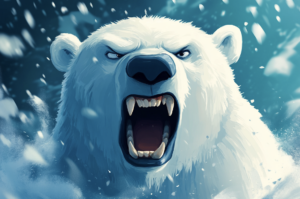
- Polar bear image
- ‘Wild Beast’ Music
Key Questions
- Why are the polar bears angry?
- How does that affect their movements?
- What is a phrase of dance?
Polar bear
Teaching Points
- Ask the children to communicate the story of Penguin Small through their bodies and not through their mouths (i.e. using non-verbal communication)
- If the children to struggling to be quiet whilst they are practising their mean and angry faces, give them permission to make noises for a few seconds, then ask them to try again without the sounds.
- When practicing the phrase, the children need to start slightly to the left-hand side of the space, so there is room for them to stomp sideways to the right
- A phrase of dance is a bit like a sentence, but expressed through movement rather than words
Lesson Content
Starter Activity
Introducing polar bears: We are going to explore another character from the story of Penguin Small – the polar bears
Question: What do polar bears look like? Ask the children to describe their features – use the image of a polar bear to aid discussion (key vocabulary – furry, big teeth, sharp claws, big and powerful)
Shape: Now ask the children to imagine that they are polar bears. Get them to imagine they are stepping inside the image of the polar bears and make a still shape like in the image.
Move: How do polar bears move? Bring these polar bears to life – get the children to move through the space as polar bears.
Discuss: Discuss their ideas afterwards. Ask the children to share what actions they chose to use to show they were a polar bear (e.g. stamping paws, gnashing teeth, swiping paws).
Improvisation: Guide the children to improvise (spontaneously try out) a range of basic actions as a polar bear…
- Gesture – what can polar bears do with their paws? And their heads?
- Turn – how can polar bears spin? Can they roll themselves around in the snow to get clean?
- Elevation – can they find different ways to hop, jump and leap as a big heavy bear?
- Travel – stomp around the room, pounce towards imaginary prey.
Finish with a big stretch – how might a polar bear stretch?
Activity 1 - Meeting the Polar Bears
Story: Share the next part of the story of ‘Penguin Small’ where the polar bears are introduced – what kind of characters are they? There are clues in the illustrations and text (e.g. nasty tricks, mean, terrible mood, rage).
Facial Expressions: How can we show that we are mean and angry with our faces? Ask the children for suggestions (e.g. bare teeth, frowning, looking about, clenched teeth). Try these ideas out with their faces, focusing on expressions rather than sounds/words.
Body Actions: How can we show that we are mean and angry with our bodies? (strong, heavy, tense, clenched fists, open chests). Try these ideas out, moving in a mean and angry way around the room as a polar bear.
Activity 2 - Polar Bear phrase
A phrase is a short sequence of movement. Teach the children the following phrase, which focuses on the polar bears, showing why the penguins left the north pole (see videos). You can learn the phrase yourself then teach it to the children, or use the video directly with the class.
This phrase, once learned will be performed by the whole class in unison and feature in the final dance in lesson 6.
- Travel – Thump the ground with the hind paws, whilst stepping to the right (Narrative – the polar bears were coming).
- Stillness – Balance in a wide stretched-out star shape on tiptoes, showing the polar bear’s enormous size. Look mean. (Narrative – the polar bears were in a terrible mood).
- Spin – Turn around on the spot, using looking gestures to try and find the penguins (Narrative – where are the penguins?)
- Gesture – Punch a fist (paw) on one hand into the palm of the other hand (paw). (Narrative – tell us where they are!)
- Elevation – Jump angrily up and down on the spot (Narrative – thump the snow with great paws in rage).
Play one of the music tracks suggested for this lesson. There are no specific counts for this phrase, the music is there to provide a mean and angry atmosphere for the children to respond to.
Ask the children to practice as a whole group. Can they all demonstrate the dance in unison? This is where everyone moves at the same time, using the same actions.
Activity 3 - Perform to a Partner
Set up: Following the same format as the partner feedbacl from last lesson. Ask the children to get into pairs and label themselves A and B. Ask all the A children to stand up together and perform their polar bear phrase to their partner. To help the children with their movement memory, you can perform alongside the children, too, or play the video. All the B children need to watch their partner.
Feedback: After the first performance, tell the B children that they will watch their partner A again, but this time they need to notice…
- How accurate their partner’s movements were – did they remember all the movements in the phrase? Were they in the right order?
- How mean and angry their partner was – did they use their face to show the emotion of the polar bears?
Ask all the B children to feedback to their partner…
- How well they remembered the phrase and how accurate it was
- Their mean and angry expressions
- What they could change about their performance to make it better?
Now swap over so that the B children perform twice and the A children watch and feedback to their partner in the same format as above.
Cool Down
We are ending the session now and don’t need to be polar bears anymore – brush away our fur, sharp teeth, paws and mean/angry faces.
To finish off we will warm ourselves up with some hot chocolate. Ask the children to imagine they are holding a warm mug of hot chocolate. Slowly breathe in the smell through the nose, then blow out through the mouth to cool the drink. Repeat a few times. Then drink the hot chocolate, noticing the warm sensation travelling down to our tummies and then along our limbs.