Year 3 Netball Lesson 5
Lesson Summary
Learning Intentions
- Throw over longer distances using shoulder pass
- Recognise which throw is needed over shorter & longer distances
- Use shoulder pass in a game to build attacking play
Success Criteria
- I can explain when a shoulder pass is used
- I can achieve a greater distance using a shoulder pass
- I can work as part of a team to score points
We are Learning...
to throw for distance using a shoulder pass.
Curriculum Links
NC Apply and develop a broader range of skills, learning how to use them in different ways.
L Explain the difference between short and long passing.
N It is 8.55 and the PE lesson starts at 9.00. How many minutes until 9.00?
Equipment
- Cones
- Netballs
- Bibs
- Shoulder Pass presentation (attached to the lesson plan)
Key Questions
- Why would we use a shoulder pass? (to throw the ball over a greater distance)
- How did you work with your team to attack and score points?
- Did your heart rate rise during today’s lesson? When? Why does this happen?
Shoulder Pass
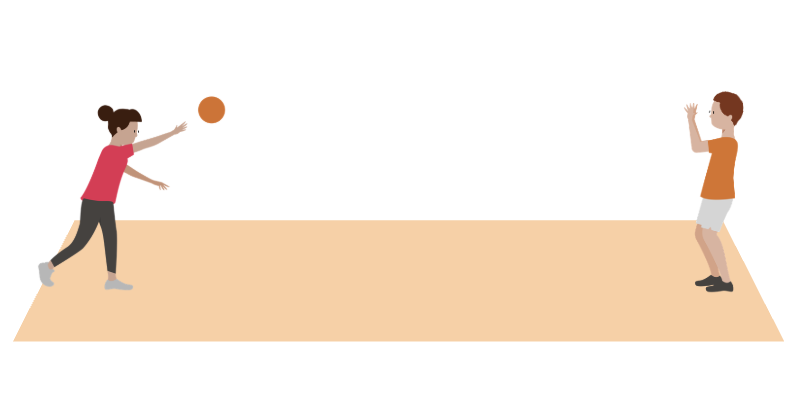
What is a shoulder pass?
The shoulder pass is used in netball to throw the ball accurately over a longer distance, especially when a teammate is further away or space needs to be covered quickly. It is chosen because a chest pass may not travel far enough with control, whereas a shoulder pass allows the ball to reach a teammate safely and accurately over distance.
Teaching Points
✔︎ Shoulder Pass
- Stand side-on with opposite foot forward
- Hold the ball near the shoulder, support if needed
- Spread fingers behind the ball
- Push towards the target, transferring weight forward
- Follow through with arm and hand
Lesson Content
Starter Activity - Ball Tag
Objective: To use a range of passes to keep possession.
Set-up:
- Pupils work in groups of five.
- In each group, three pupils are passers and two are taggers.
- Use a clearly marked playing area.
How to play:
- The three passers move around the space, passing the ball to keep possession.
- The two taggers try to tag the ball holder or intercept a pass.
- If a passer is tagged or their pass is intercepted, they swap roles with the tagger involved.
- The game always remains 3 v 2.
Rules:
- Passers cannot run with the ball.
- Pupils must follow netball footwork rules when receiving the ball.
- Passes should be controlled and purposeful.
Rotation: If not occurring through the game play itself, rotate pupils within the groups regularly to keep intensity high and ensure everyone experiences both attacking and defending roles.
Focus: Using a mix of short and long passes Moving into space to support the ball carrier. Defending by anticipating and intercepting. Quick decision-making under pressure.
Discussion: What helped your team keep the ball for longer when you were passing? How did moving into space make it easier to receive a pass? What did defenders do well to tag or intercept the ball? What types of passes did you try to use?
Skill Development - Shoulder Pass
Task 1: Exploring Pass Choice (Pairs) In pairs, pupils stand facing each other about 1 metre (3 ft) apart.
- Complete four chest passes, then one pupil takes one step backwards.
- Continue until a chest pass becomes difficult to reach.
- At this point, pupils switch to a shoulder pass, using the teaching points.
Discussion: When did you need to change to a shoulder pass, and why was the chest pass no longer effective?
Task 2: Pass Selection Under Pressure (2 v 1)
Pupils work in groups of three: two attackers and one defender.
- The attackers aim to make as many successful passes as possible before the defender intercepts (can be a catch or just knocked away).
- The receiver moves into space to catch the ball.
- The thrower chooses whether to use a chest or shoulder pass based on distance and pressure.
- Attackers must keep moving, changing distance and direction (forwards, backwards and side-to-side).
- Players must stay within their grid
Easier: Larger grid. Play 3 v 1.
Look for: Team of 2 – Choosing the right pass for the distance. Moving into space to receive. Quick decision-making while under pressure. Good communication with the partner. Attempting a shoulder pass. Defender – staying focused and determined. Recognised success if knocked away OR intercepted.
Assessment for Learning - Cone touch challenge
Objective: Attackers score points by touching a cone with the ball before the defender intercepts the pass or touches the player holding the ball.
Set-Up: Mark out a small playing area.
- Place four cones randomly around the area
- Play 3 attackers vs 1 defender
How to Play:
- Attackers work together to keep possession and score points
- To score, a player must touch a cone with the ball under control
- Teams cannot score on the same cone twice in a row
- The defender tries to intercept passes or touch the player with the ball
- If the defender wins the ball or makes a successful touch, play restarts from a sideline
Rules:
- No physical contact
- Players cannot run while holding the ball
- Attackers should move into space to support teammates
- Encourage quick passing and smart decision-making
Rotation: Rotate roles regularly so all pupils experience attacking and defending. Change groups occasionally to provide different levels of challenge.
Easier: Add a fourth attacker. Add an extra scoring cone. Harder: Remove one scoring cone. Play 3 v 2. Make the court larger.
Look for: Players moving into space quickly. Accurate chest and shoulder passes. Eyes up before passing. Communication between teammates. Quick passes if to avoid being tagged. Quick decision-making when to attempt to score or pass to remain safe. Defender staying alert and applying pressure.
Discussion: What helped your team score points without being intercepted? When did you use a shoulder pass and why? How did moving into space make passing and scoring easier? What did the defender do well to put pressure on the attackers? How did the rule about not scoring on the same cone twice change your decisions?