Year 5 Athletics Lesson 6
Lesson Summary
Learning Intentions
- Work in small groups to design a running, jumping or throwing event.
- Teach the event to another group.
- Give thoughtful feedback based around the STEP principle
Success Criteria
- I can explain the STEP principle.
- I can select equipment suitable for my event.
- I can work with others to plan and teach an activity.
We are learning...
to design a run, jump or throwing activity for others using the STEP principle
Curriculum Links
NC Think about important aspects needed to plan an event
L Speak clearly and confidently to explain an activity.
N Measure or time runs, jumps and throws accurately.
Equipment
- Tennis balls
- Sets of equipment for each group, e.g. cones, tape measure, stop watches, throwing equipment
- Paper or whiteboards
- Pens
Key Questions
- What does STEP stand for?
- How can changing one element (e.g. space) affect an activity?
- Why is it best not to change too many things at once?
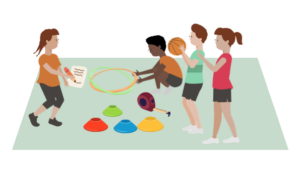
Plan an activity
STEP
Teaching the STEP principle
- S = SPACE
- T = TASK
- E = Equipment
- P = People
STEP
The STEP framework is designed to support effective teaching and learning in PE. It provides a simple way to adapt, differentiate, and extend lessons and activities. Over the past 10 years, STEP has been widely promoted through PE resources and CPD courses, and is often used by children in leadership roles such as Young Leaders or Sports Leaders. Its strength lies in its simplicity, which has made it a popular tool applied in many different ways across PE and sport.
Lesson Content
Starter Activity
Ball Tag– The objective of the game is to avoid being tagged by the tagger.
Set up:
- Split the class in half and have two games of 15.
- Each group has one person who is the ‘tagger’
- Each group has two tennis balls/soft balls
Rules:
- Players holding a ball cannot be tagged.
- Players pass the ball to protect teammates (as cannot be tagged when holding ball).
- If tagged, players must freeze.
- Game ends when only the 2 players with balls remain unfrozen.
Extension: 1) Tagged players become taggers. 2) Players can release teammates who are frozen by giving them a high five. 3) Add another tagger.
Look for: Clear understanding of how they can avoid being out by passing the ball to protect a team mate. Collaboration as the running team to want to help each other. Determination by the tagger to keep trying. Safe play considering space and others moving in it.
Activity
Split the class into 4 or 6 even groups. Each group are going to plan a running, throwing, or jumping event. Give each group the STEP planning sheet in the resource section below to support.
Task: Each group should
- Select an Event: Choose whether you want to plan a running, jumping, or throwing activity. Each group needs to plan only one event.
- Use Resources Provided: The teacher will provide each group with a set of equipment and a designated space to work on your event.
- Plan Your Event: You will be given a specific amount of time to plan your event. Use this time effectively to get your activity ready.
- Teach and Learn: Once planning time is over, pupils teach their activity to another group. After teaching your session, learn the activity planned by another group.
- Optional Competition: Consider turning the activities into a competition where groups can earn points based on their performance in the activities.
- Tools for Planning: It may be useful to use whiteboards or paper and pens for mapping out ideas. Also, think about creating a scorecard that fits your activity.
Extension: If a group finishes early and feels ambitious, they can start designing an additional event.
Safety: Make sure the children consider safety when setting up the activities. Are there any specific rules that should be introduced to make sure everybody is kept safe?
Discussion: How did you use your planning time wisely to create your task? Why is the organisation of the people taking part important to consider when planning your activity? Why is it essential to select the correct type of equipment for your activity? How did you choose the space you will need to deliver the activity?
Considerations to guide pupils through their activity
- Running – Decide if it will be an individual sprint or a team relay.
- Throwing – Choose the type of throw and the most suitable equipment.
- Jumping – Will pupils jump for height or distance, from standing or with a run-up?
- Space – Check how much space you have and organise activities safely.
- Equipment – Make best use of what is available.
- Grouping – Use small groups so pupils stay active and avoid waiting.
- Scoring – Decide how to measure success (time, distance, points, accuracy).
- Teaching Points – Keep instructions simple so pupils can quickly teach their event to another group.
Changing the activity using STEP:
Once pupils have used the handout to plan the activity, they can then apply the principle to change elements of the activity if they are not working or need improving.
E.g., they consistently throw the ball beyond the space available; Change the space by increasing the area if possible, or change the equipment so they cannot throw as far e.g from a tennis ball to a foam ball.
Group delivery and feedback
Once groups have planned, organised and practised their activity, pair groups together. One group delivers and explains their activity while the other group takes part. After a set time, swap roles so each group has a chance to lead and participate.
After both activities, pupils give peer feedback to each other using the STEP areas:
- Space – Was the space organised safely and clearly? Did it help the activity work well?
- Task – Were the instructions easy to understand? Was the activity fun and challenging?
- Equipment – Was the equipment appropriate, was there enough for all players?
- People – Did the group understand what they were doing and work well together?
Encourage pupils to give:
- one thing the group did well
- one suggestion to improve the activity even further.
Extension: If time allows, allow groups to swap and deliver their activity again to a new group and play in that group’s activity.
Look For During Delivery: Clear explanations and demonstrations of the activity. Safe organisation of space and equipment. All group members involved in leading the activity. Positive communication and encouragement within the group. Pupils adapting or solving problems independently. Participants understanding the rules and staying engaged. Good teamwork, turn-taking and cooperation.
Look For During Peer feedback: Pupils using the STEP areas (Space, Task, Equipment, People) in their feedback. Feedback that is specific and helpful rather than just “good” or “bad”. Pupils identifying strengths as well as improvements. Respectful listening when others are speaking. Groups responding positively to suggestions. Children explaining why something worked well or could be improved.