Year 5 Football Lesson 1
Lesson Summary
Learning Intentions
- Turn with the ball unchallenged
- Receive the ball and turn into space
- Receive the ball and turn to shoot
Skill Development Turning with the ball
Success Criteria
- I can change direction with the ball
- I can turn into space
- I can sometimes turn with the ball during games
We are Learning...
to turn with the ball.
Curriculum Links
NC Select and combine more complex skills in game situations.
L Use appropriate language to help and encourage teammates to turn with the ball.
N Estimate the degree to which they are turning is it 45 or 180 etc.
Equipment
- Cones
- Footballs
- Bibs
Key Questions
- How did turning with the ball help you keep possession or escape pressure?
- How did you decide whether to turn, pass or shoot in different situations?
- How did your movement and positioning support a teammate after they turned?
Turning with the ball
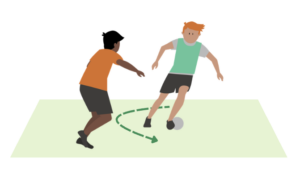
Why should we be able to turn with the ball?
Being able to turn with the ball while keeping it under control is important in football because it helps players change direction to escape pressure, keep possession, and find space. After a turn, a player should look to shoot, pass or dribble.
Teaching Points
✔︎ Turning with the ball
- Look for space to turn into
- Ensure the ball is close and is under control before you start turning
- Use the closest foot to turn.
- Take a soft touch into space.
- Accelerate away after the turn
Lesson Content
Starter Activity
Football Traffic Lights – Each child should have a ball in an area of approximately 20m x 20m. Children should respond to the following commands to move around but must stay within the 20 x 20 grid.
- Red = Stop with one foot on the ball.
- Green = Move around the area within the grid, keeping the ball close to your feet.
- Amber = Walking with the ball at their feet.
- Roundabout = Turn/change direction walking with the ball (keeping it under control).
Teaching focus: Close control, awareness of space, stopping and starting with the ball, and quick reactions.
Safety: Encourage pupils to keep their heads up and avoid collisions.
Extension:
- Add a Blue command: pupils perform three toe taps on the ball, then continue dribbling.
- Add a Purple command: pupils shield the ball for 5 seconds using their body.
Harder: Introduce speed changes on Green (slow → fast). Reduce the size of the grid to increase challenge.
Skill Development - Turn and Pass
Set-up:
- Split the class into groups of four.
- Mark out a 10 m × 5 m rectangle.
- One pupil stands at each end of the space with a ball.
- The remaining two pupils stand back-to-back in the middle (see diagram).
How to play: See video
- The pupil at one end rolls or passes the ball to the middle player facing them.
- The middle player receives the ball, turns to their right, and passes it to the pupil at the opposite end.
- The ball is then sent back in the same way.
- After a set time, rotate the middle players so everyone practises turning.
- Once each player has had several attempts at turning to the right – switch it and turn to the left.
Encourage pupils in the middle to give each other simple, constructive feedback using the key teaching points.
Teaching focus: Receiving, turning with control, awareness of space, and accurate passing.
Extension: Turn and Shoot
- Pupils at each end become goalkeepers.
- Play with one ball only.
- One middle player receives the ball and attempts to turn and shoot past the goalkeeper.
- The second middle player acts as a passive defender, trying to block or slow the turn.
This adds decision-making and pressure while reinforcing turning skills.
Discussion: What helped you control the ball when receiving and turning? How did your body position affect how quickly you could turn and pass or shoot? Can you think of situations in a game when you might use this skill?
Activity - Assessment for learning
Set-up:
- Play a 4 v 4 game using the largest pitch the space allows.
- Use a relatively large goal compared to the pitch width to encourage scoring.
- Mark out a ‘D’ zone in front of the goal.
- Pupils must be outside the D to shoot.
Assessment focus (teacher observation): Look for pupils:
- Applying turning skills to change direction, escape pressure, or create space.
- Showing game awareness, including movement into space, decision-making, attack and defence principles and supporting teammates.
- Demonstrating understanding of when to turn, pass, shoot or dribble during play.
Easier: Allow one attacker to shoot from inside the D. Reduce team size (e.g. 3 v 3) to increase involvement.
Harder: Reduce the goal size or make the pitch smaller to increase pressure or larger to force more movement.
Discussion: When did turning with the ball help you keep possession or create space? How did you decide whether to turn, pass or shoot in different situations? What helped your team support the player on the ball? How did the D-zone rule change where and when you chose to shoot? Can you think of any other sports where you could adapt and apply these turning skills?