Year 6 OAA Lesson 4
Lesson Summary
Learning Intentions
- Work cooperatively to solve team challenges.
- Develop trust and control in partner/group movements.
- Persevere to learn a new skill of tying a reef knot
Success Criteria
- I can work well in a pair or group
- I can persevere and keep trying at a task
- I can tie a reef knot
We are learning...
to work together, stay in control, and persevere when solving physical challenges.
Curriculum Links
NC Compare performance with previous performances and demonstrate improvement to achieve personal best.
L Work in pairs and small groups to solve problems.
N What do we mean by opposing forces? How are they used in the back-to-back activity?
Equipment
- A range of different-sized balls or equipment for activity 1
- Ropes or thick twine, enough for one between two or three pupils
- Reef knot instructions print out
Key Questions
- What was your favourite activity today and why?
- What are the key uses for a reef knot?
- Can you think of any practical ways you could use a reef knot?
Reef Knot
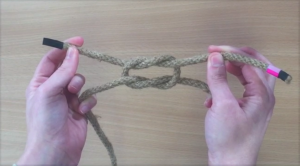
Reef knot
The reef knot is a binding knot used to hold things together, such as parcels or a triangular bandage. It is designed to be used with a single piece of rope and should not be used to tie two different ropes together.
Teaching Points
Back to back
- Partners stand back to back
- Feet flat on the floor
- Press backs against each other to create resistance
Easier Link arms to help stabilise themselves.
Lesson Content
Starter Activity - Question Tag
Set up: Set all pupils along one side of the hall or playground. You stand in the middle as the first tagger.
How to play: Explain that you will ask a question, and if the statement is true for them, they must run to the opposite side without being tagged.
Example questions: “Do you have an older brother?”. “Do you have a younger sister?”. “Do your parents have a blue car?”. “Do you have a pet?”
When pupils run, try to tag them before they reach the other side. Anyone tagged becomes a tagger and joins you in the middle. Continue asking new questions, alternating the direction pupils run each round. As more pupils are tagged, the tagging group grows, and it becomes harder to get across.
Play until most pupils have joined the tagging team, then reset for a new round with a fresh starter tagger.
Rules: No blocking runners. Light touch only. Be honest when tagged
Activity 1 - Reach it
Objective: To develop pupils’ teamwork, communication and problem-solving skills as they work together to find safe and creative ways for the whole group to connect with progressively smaller objects.
Set up: Divide the class into groups of approximately 8. Each group needs at least 4/5 pieces of equipment that reduce in size, such as a range of balls, but anything that is accessible and safe will do.
How to play:
- Taking the largest object first, the group must arrange themselves so they are all touching the object.
- They CAN NOT touch each other or hold each other up
- When they are all successfully touching the object, they can move onto the next object in size, working their way down to the smallest one.
Easier: 1) Have fewer pupils in each group. 2) Give a selection of larger pieces of equipment. 3) They can touch each other but not hold one another up.
Harder: 1) Increase the number of players in a group. 2) Try adding another object so there are two items they must touch.
Discussion: What communication helped you organise yourselves quickly and safely? What did you find most challenging as the objects got smaller, and how did your team adapt? How did you make sure everyone in your group was included and had space to participate? What strategies helped your group stay balanced and avoid touching each other? If you played again, what would your group do differently to complete the challenge more efficiently?
Activity 2 - Back to back
Set up: Organise pupils into pairs. Their challenge is to work together to lower themselves to the floor and return to standing without using their hands.
How to play:
- Each pair begins standing back-to-back with their feet firmly planted.
- They must communicate and apply equal, controlled pressure against each other’s backs to lower themselves into a seated position.
- Once seated, they repeat the process in reverse, using shared force and timing to stand back up.
- Emphasise slow, coordinated movements and clear communication to maintain balance and safety.
Extension:
- Option 1: Join two pairs to form a group of four and attempt the same sit–stand challenge.
- Option 2: Increase the group size gradually and see how many pupils can safely complete the task together.
Discussion: How did you and your partner communicate to make sure you moved at the same time? What was harder – sitting down or standing up? Why do you think that was? Why is perseverance important when trying out difficult tasks? Why is persevering a good skill to develop? How does it help us in life?
Activity 2
Objective: To develop pupils’ perseverance and problem-solving skills as they learn to tie a reef knot.
Set up: Pair pupils and provide each pair with a rope and an illustrated handout. If helpful, show the demonstration video beforehand so pupils have a visual reference.
How to play:
- Each pupil begins by practising the knot independently, using the handout to guide each step. Encourage them to take their time and persevere if it doesn’t work the first time.
- Partners may offer verbal prompts or simple reminders, but should avoid taking over – this helps each pupil build confidence and understanding.
- Once a pupil can tie the reef knot using the instructions, challenge them to tie it again without referring to the handout, using memory and repeated practice to build fluency.
Extension:
- Working as a pair, each pupil holds one end of the rope and attempts to tie a reef knot together. This requires clear communication, cooperation and coordinated movements.
- When successful, pupils swap partners and try again, applying what they’ve learned with someone new.
Discussion: What was the hardest part of learning to tie the reef knot? What did you do when your first attempt didn’t work? How did perseverance help you improve? How did practising step-by-step with the handout support your learning? How did your partner help you without doing the task for you? Why do you think perseverance is important when learning a new physical skill like knot tying? What did you learn about yourself when you kept trying, even when you felt stuck?