
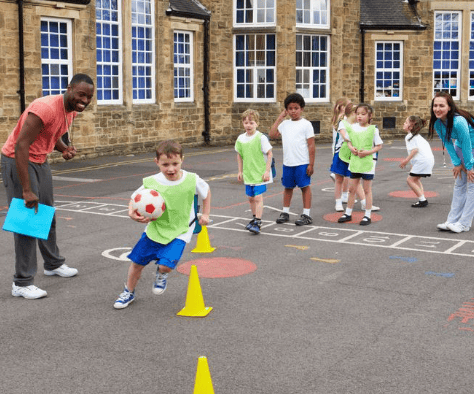
Basic Primary PE Exercises List
Fun PE Exercises for Kids
Physical education is a fantastic way to get children moving, build coordination, and develop teamwork skills. Activities should be adapted to each age group to ensure that kids are engaged, challenged, and safe. You can find more ideas for tagging games for primary schools in our blog here. Below, we break down fun PE exercises for each stage of learning in primary schools.
Reception
At this early stage, children are developing basic motor skills and learning how to follow instructions. The EYFS Statutory framework says activities should be simple, playful, and imaginative.
Examples include:
Telling stories through actions
Prepare: Discuss the role of a firefighter with the children – what do they do in their job? What do they need to wear for their job?
Now tell the children that they are going to become firefighters today. They need to look the part, so they will need to get dressed just like a firefighter. Ask the children to mime putting on the firefighter’s clothing, using ideas from your discussion, such as boots, face mask, helmet, and gloves. They now look the part!
Activity: They are now going to move like a firefighter too. Ask the children to do some movements that represent some of the activities they mentioned in the discussion.
For example…
- Climbing a ladder – co-ordinate the arms and legs to make it look like they are climbing a ladder. As well as standing up and imagining the latter is vertical, you could also practice using horizontal ladders (so climbing along the floor).
- Crawling under smoke – travel right down low on their bellies so they don’t inhale the smoke
- Tiptoeing – moving lightly and carefully so they don’t fall down from a height
- Driving a fire engine – using driving actions to travel carefully to the fire
- Extinguishing the fire – using gestures to mime holding a hose spraying over the fire
Ask the children to try out these firefighter actions by themselves. They can move around the room, imagining they are travelling to the scene of the fire.
Balancing a beanbag as an individual
Each pupil has their own beanbag but shares a working space on a mat with a partner. Taking them through each position at a time, ask pupils to balance the beanbag without it falling to the ground.
1. Walking - Can they walk whilst balancing the beanbag on their head, shoulders, fore/backhands, fore/back arm, or upper arm?
2. On hands and knees - Can they crawl on hands and knees while balancing the beanbag on their head, upper/lower back, shoulders, backs of legs, and soles of feet?
tummy, thighs, and tops of feet?
Once you have run through these variations, ask the children if they can develop ways of moving themselves whilst balancing the beanbag; suggestions may include sliding like a snake or walking like a duck.
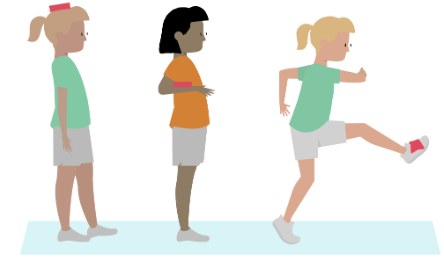
Parachute Games
Begin by spacing children out around the parachute. When children are in position, practise making waves with the parachute. Ask children to practice making small, medium and larger waves by varying the up and down movement of their arms.
Game 1 – Place a ball on the parachute. Work together to roll it around the edge or try to land it in the middle hole (if your parachute has one).
Game 2 – All children squat down, holding onto the parachute. On the teacher’s count of three, all children stand up and raise their arms above their head as quickly as possible. Hold up in the air (this can form the space for other games). Repeat several times until it is being raised at the same time on all sides.
Game 3 – Lift the parachute (as in Game 2). Call two names; those children run under the parachute and swap places. Remind them to avoid bumping into each other. Extension: Count how many swaps can be made before the parachute falls.
Game 4 – Assign colours from the parachute to children. When you call a colour, those pupils swap places by running under the parachute.
Game 5 –Place lots of beanbags and soft balls on top of the parachute. Children can make waves and watch the balls/beanbags bounce around like popcorn. How long can they keep all the popcorn on the parachute?
For more ideas, check out our Free Reception PE lesson plans and resources.
Key Stage 1
In the KS1 PE National Curriculum, children can handle slightly more structured activities that develop agility, balance, and basic game skills
Examples include:
Balance Beam Games
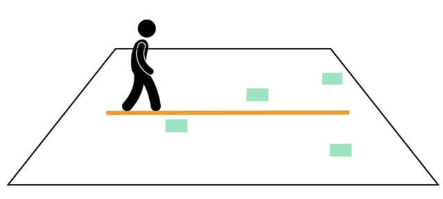
Give each child their own line to work on, if you do not have floor markings, use non slip tape to mark out a 1.5 – 2m line for each pupil to work on. The aim is for the children to stay balanced on their line and not stray off it, like a tightrope. Start with simple instructions to get them warmed up:
- Move along your line one foot in front of the other, now try toe to heel, now try going backwards.
- Move along your line sideways, left foot leading first then right foot leading.
- Move forward each time you put a foot forward, bend and touch the toes of your lead foot e.g. right hand to left foot, if able do in reverse.
- Scatter a couple of bean bags either side of the line, children must pick them up (easier closer to the line, harder further away).
Extension: If time pair pupils up. One partner stands on their line, the other partner stands 2-4 metres away and tries to throw balls and hit the person balancing. Underarm throws only, using a soft ball. The person balancing must try and dodge or step up and down the line to avoid the balls without stepping off!
Snatchers and Catchers
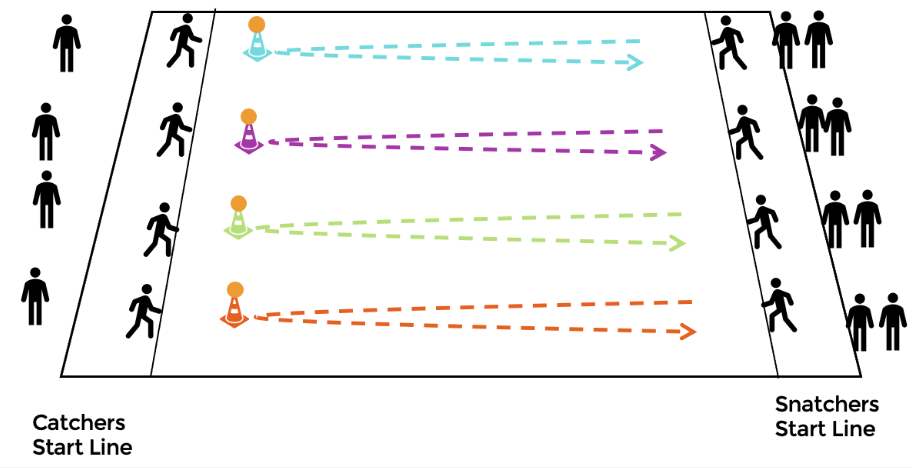
Set Up: Organise pupils into groups of 5.
- Position 3 snatchers at one end and 2 catchers at the other.
- Place a ball on a cone between the two lines, closer to the catcher's line.
- Set up the area as shown in the diagram.
How to Play
- The first snatcher and catcher step up to their lines.
- On the teacher’s command, the snatcher runs to grab (“snatch”) the ball from the cone.
- As soon as the snatcher picks up the ball, the catcher can give chase.
- The catcher tries to tag the snatcher before they cross back over their start line.
- After the turn:
- The catcher joins the back of the snatchers’ line.
- The snatcher replaces the ball and joins the back of the catchers’ line.
Teaching points: Introduce hips to lips running technique and then put them back into the game. Continue until all pupils have had several turns.
Discussion: What helped you run faster when chasing or escaping? What could you do next time to avoid being tagged or to tag the runner more quickly? How did it feel when you were the snatcher compared to when you were the catcher?
Hoop Game
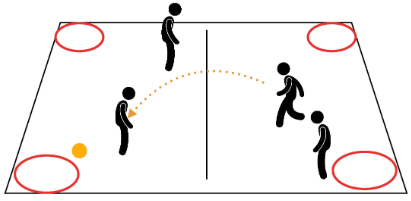
Pupils are put into pairs and positioned approximately 2m apart with a hoop and a defending line each (see diagram above). The game aims for one pupil to try and throw their beanbags into their opponent’s hoop whilst their opponent tries to defend. Once they have thrown all of their beanbags, swap roles. The defender will now be the attacker and vice-versa.
Easier: Use larger hoops or make a larger target area. Add two hoops instead of one.
Harder: Make target area/hoop smaller or move hoops further away.
Extension: Play 2 v 2 with two hoops to defend. Place the hoops side by side, on a diagonal or one behind the other. One team are the attackers and one the defenders, taking turns with 3 balls. Now play an 'open game' with one ball. Both teams can attack and defend. Pairs must make one pass before they can attempt to shoot. If a player intercepts a shot on goal, they can immediately counterattack.
For more ideas, check out our Free KS1 lesson plans and resources.
Key Stage 2
The KS2 National Curriculum says children should focus more on developing their knowledge of a range of activities and on strengthening teamwork and strategy.
Examples include:
Target Ball
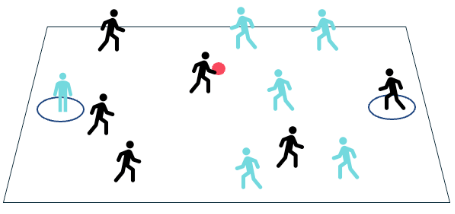
Objective: Play a netball-style game where teams pass the ball to score in their hoop and try to stop the other team from scoring.
Set-Up: Play 6v6, one court per game, with a hoop at each end.
How to Play:
- One player from each team starts in the hoop.
- Others move freely, throwing and catching, but must stop when holding the ball.
- Teams score by throwing to their hoop player, who must catch it.
- Restart after a goal from the centre, alternating turns for the centre pass.
Rotation: After scoring, the thrower swaps with the hoop player. Play continues.
Check out our netball activity area for more guidance and ideas for teaching netball in your school.
Nest Ball
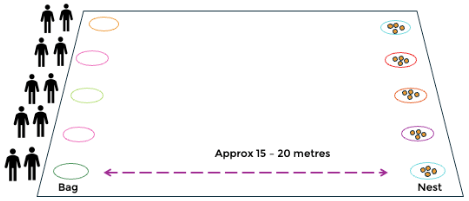
Objective: Pupils must move all four eggs from the nest to the bag and then return them to the nest as quickly as possible.
Set up:
- Pupils work in pairs, each with two hoops: one is the bag and one is the nest.
- Leave 2–3 ft between pairs to allow safe movement.
- Place the bag and nest hoops 15–20 m apart.
- Put four eggs (balls) in each nest.
- When a pair finishes, they sit behind their hoop to show they are done.
Rule: Only one player can touch/hold/carry an egg at a time. They cannot both be in contact with an egg each.
Brainstorm: Before starting, explain the task and rule. Give pairs a few minutes to plan their strategy - how they will move, swap roles, and stay safe. (Ideas children may come up with: sprint between the hoops one at a time, run half way and give the egg to their partner who runs the rest, throw/pass the eggs or a combination.)
Rotation: Complete the challenge once, then pause to discuss improvements or changes to technique. Play again to see if they can beat their first time.
Extension: Put two pairs together into a group of four. They must now repeat the activity. How does it change their options to move the eggs?
Discussion: After the first round - What strategy did you use? Did you communicate well? Before second attempt/group attempt - what will you change this time? What definitely did not work? Why is doing your best so important to the success of your strategy?
Create a Secret solo
Select: Choose between 3 and 5 actions that all travel off the spot. The children need to arrange their actions in an order, it doesn’t matter which order they choose, but they need to be able to remember and repeat the dance in the same order every time.
Connect: Get the children to consider how each action might connect together. Can they make each action link from one to the next so there is a flow between them all (rather than stopping and starting)?
Start and end: Now, choose a start and end position
Practice: Ask the children to practice their phrase several times over in the right order (start still image, 3-5 actions, end still image) to build confidence and movement memory.
Check out our dance activity area for more guidance and ideas for teaching netball in your school.
For more ideas, check out our Free KS2 lesson plans and resources.
Primary PE Warm-Up Activities
Warm-ups are essential to prevent injury and prepare the body for exercise. A good warm-up should raise the heart rate, loosen muscles, and engage children’s minds. Here are ideas for primary school students:
Follow the Leader
Start in a circle with the teacher as the leader. The teacher will perform basic travelling actions - walking, hopping, skipping, jumping, etc. Begin by moving in a circular motion and then around the room with children following.
Extension: Ask children to work in twos and play follow my leader, changing the leader regularly. Encourage the children to use different actions, speeds, directions, and levels
Change
Children should move around the playing area, in and out of spaces. On command, children should respond with different actions. During the commands, children should think about where the power is coming from to perform the action. Here are the commands: 1. Touch the floor and then continue running 2. Jump off both feet as high as they can and then continue running 3. Freeze and remain still 4. “ALL CHANGE”, children should change direction immediately
Shape Freeze
Pupils need to move around the area using a variety of travelling actions, teacher shouts FREEZE and children must show a shape and hold it for three seconds before moving on. Encourage children to use different actions, levels, speeds and pathways.
For more warm-up ideas, check out our free activity booklet.
Simple PE Stretches for Children
Stretching helps improve flexibility, reduce the risk of injury, and cool the body after PE activities. Here are simple stretches suitable for children:
· Toe Touches: Reach for the toes while keeping legs straight.
· Side Stretches: Reach arms overhead and lean gently to each side.
· Arm and Shoulder Stretch: Cross one arm across the chest and hold with the other.
· Butterfly Stretch: Sit with soles together and gently flap your knees.
· Star Stretch: Stand tall and stretch arms and legs wide like a star.