Year 4 Gymnastics Unit 1 Lesson 6
Lesson Summary
Learning Intentions
- Enhance their existing sequence and perform it to be judged
- Use a judging system to evaluate a group sequence
- Use feedback to make improvements to their performance
Success Criteria
- I can explain what the judge is looking for
- I can use a judging system
- I can use my score to help me improve
We are learning...
to judge a performance and use feedback to improve
Curriculum Links
NC Perform a group sequence and take on the role of a judge to evaluate others’ performances.
L Spell the word ‘notice’ and use it in a sentence about today’s lesson.
N Solve: An Olympic gymnastics team scored 40 points. If ¾ were from floor events, how many points were won on floor? (Answer: 30 points)
Equipment
- Mats
- Printed resources (attached to the lesson plan)
Key Questions
- What were the four things the judges were looking for in today’s routines?
- How did your group use the feedback or scores to improve your performance?
- What things should you be mindful of when you provide feedback to others?
Judging
Judging in Gymnastics
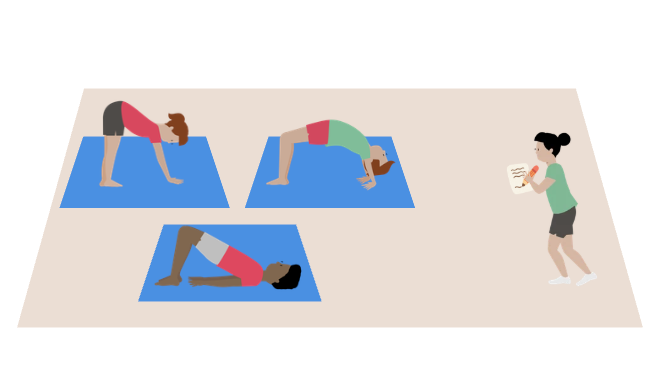
Judging systems in gymnastics help decide how well a sequence has been performed. Judges look for creativity, meaning how interesting and imaginative the routine is. They also look at technique, such as pointed toes, straight shapes and controlled balances. In group work, judges check teamwork and timing, making sure everyone is involved and working together. These judging criteria help pupils understand what makes a strong performance.
Teaching Points - Judging
- Watch the whole performance, including actions, transitions and body control
- Look for creative sequences, travel, balances, rolls and jumps
- Check for good technique, such as straight legs and pointed toes
- Notice teamwork and how well the group works together
Lesson Content
Starter Activity - Zone Tag
Purpose: Use this pulse-raising activity to prepare pupils physically and mentally for exercise at the start of the lesson.
Set-up:
- Divide the hall into four zones using cones, spots or lines
- Choose one tagger for each zone wearing bibs
- Taggers must stay inside their own zone
- All other pupils are runners and may move between any zone
How to play:
- Runners try to avoid being tagged
- If a runner is tagged, they become the new tagger and must stay in that zone
- The previous tagger joins the runners
- Continue playing, swapping roles as needed
Look for: Moving safely with control and awareness. Quick changes of direction and speed. Using space to avoid taggers. Keeping heads up to avoid others. Increasing heart rate and body temperature ready for exercise.
Skill Development
Gymnastics judges use criteria to decide how well a sequence has been performed. Pupils should understand what judges are looking for so they know how to improve their routines.
Use the judging handout below to explain the four judging areas:
𝟏 Execution
- 3 points – Actions are performed smoothly and with control; there are no falls or errors.
- 2 Points – Actions are mostly smooth, with minor errors.
- 1 Point – Actions lack smoothness and control; multiple errors occur.
𝟐 Creativity
- 3 points – The sequence is highly creative, with imaginative movements or combinations.
- 2 Points – Some creativity is evident in the sequence.
- 1 Point – The sequence shows minimal creativity, mainly consisting of basic movements.
𝟑 Technique
- 2 points – Correct technique is consistently demonstrated throughout the performance.
- 1 point – Correct technique is shown in some parts of the performance.
𝟰 Teamwork and cooperation
- 2 points – excellent teamwork is displayed, with all members contributing and coordinating well.
- 1 point – Some teamwork and cooperation are evident, though not consistently.
Discussion: What makes a sequence look smooth and controlled? How can you make your routine more creative? Why is cooperation important in group gymnastics?
Activity - Judge and improve
Objective: To create, perform and improve a group gymnastics sequence using judging criteria and peer feedback.
Part 1 – Create the Sequence
In groups of 4, give pupils the routine ideas handout and judging sheet. Groups should create a gymnastics sequence using ideas from previous lessons while ensuring they include the required elements from the handout.
Part 2 – Judge and Feedback
Pair each group with another group.
- One group performs while the other group judges using the judging sheet
- Groups then swap roles
- Pupils may complete one judging sheet together or score individually and calculate an average score
After performing, judges should provide:
- Scores for each category
- Positive feedback
- One or two suggestions for improvement
Part 3 – Refine the Sequence
Groups return to practise and improve their routine using the feedback they received.
Encourage pupils to focus on areas that will improve their score most effectively.
Part 4 – Perform Again
Groups perform their improved sequence to their paired group again.
Compare scores and discuss:
- Did the performance improve?
- Which areas improved the most?
- How did feedback help develop the sequence?
Look for: Pupils making reasoned judgments in line with the criteria. Offering constructive feedback in a sensitive manner. Receive feedback graciously and listen to helpful ideas. Apply the feedback to improve their sequence.