Year 4 Tag Rugby Lesson 2
Lesson Summary
Learning Intentions
- To pick up the ball quickly and effectively.
- To keep possession by supporting the ball carrier.
- To work as a team to move the ball into space and attack.
Success Criteria
- I can pick up the ball quickly and with control.
- I can move into space to help my team after a tag.
- I can communicate with my team to keep the attack going.
We are learning...
to pick the ball up from the floor and run with it to start an attack.
Curriculum Links
NC Developing flexibility, strength and attacking tactics.
L There are 15 women on the England rugby team. Spell women
N What are the lines of symmetry for the grid squares?
Equipment
- Rugby balls
- Other balls (footballs, basketballs etc)
- Cone
- Hoops
- Tag belts/Bibs
Key Questions
- Why do we want to step over the ball with our leading leg? (E_asier to collect and protects the ball.)_
- How could we create space when we receive the ball? (Changing speed)
- How many hands should we carry the ball with? (Two hands in W grip)
Picking up the ball
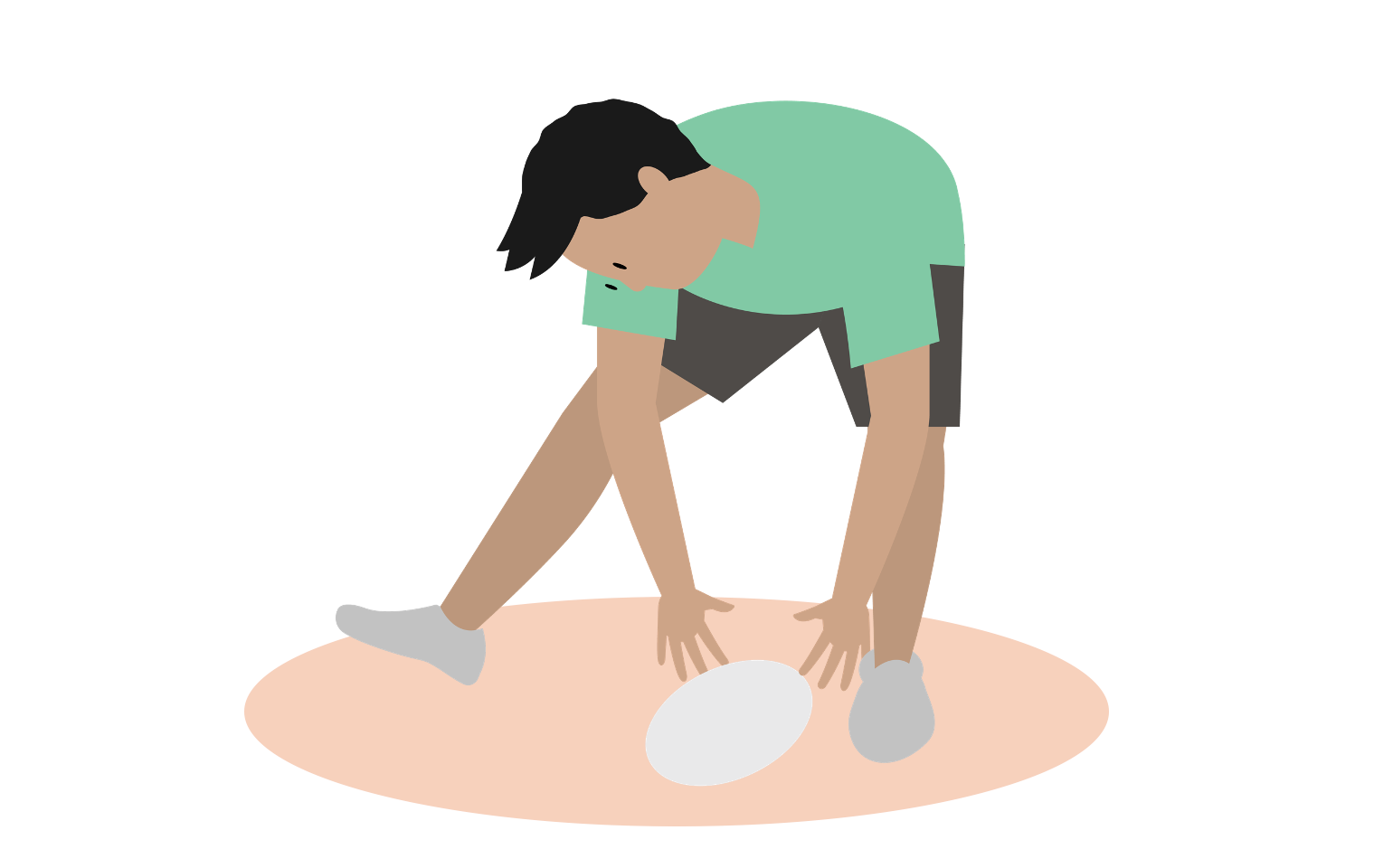
Picking up the ball
Picking up the ball is a key skill in tag rugby because the ball often goes to the ground after a tag, and a quick, controlled pick-up keeps the game flowing and helps teams maintain possession. Strong pick-up skills allow pupils to transition smoothly into running or passing, creating more attacking opportunities and confident game play.
Teaching Points
✔︎ Picking up the ball
- Step over the ball with the leading leg and place it next to the ball (to protect it)
- Bend your knees, keep your back straight, and lower your body to scoop the ball cleanly
- Secure the ball in both hands
Lesson Content
Starter Activity - Up / Down
Each pupil moves freely around the playing area carrying a ball (any type of ball can be used if rugby balls are limited e.g. football, netball). Encourage pupils to travel at different speeds and change direction to avoid others.
- When the teacher calls “DOWN”, pupils carefully place their ball on the floor and continue jogging around the space without a ball.
- When the teacher calls “UP”, pupils collect the nearest ball with two hands and continue moving around the area.
Remind pupils to pick the ball up smoothly and under control, keeping their head up and remaining aware of the space and other players around them.
Extension: Add in the call of “Swap” pupils must find a partner, and then exchange their balls by throwing them at the same time. Change the way of travel e.g. skipping, side step, walking backwards etc.
Look for: Head up and eyes looking for space. Controlled movement and changes of direction. Safe awareness of others to avoid collisions. Quick reactions to the commands. Smooth ball pick-up with two hands, without stopping completely. Clear communication between partners when swapping the ball.
Activity 1 - Robbing the Nest
Set up: Split the class into 5/6 even teams. Each team has a home nest (a hoop). Place a central nest in the middle of the area containing rugby balls (or a range of large balls if rugby balls are limited). At least one ball per player.
How to play:
- One pupil at a time runs from their team to the central nest.
- They pick up one ball, carry it back, and place it carefully into their team’s hoop.
- Balls must be placed, not dropped (dropping counts as a knock-on).
- Only one runner per team at a time and one ball per run.
Continue until the central nest is empty or for a set time.
Organisation: For large classes, create more teams or set up multiple games. Play several short rounds to keep intensity high.
Teaching points: Encourage pupils to pick up with two hands, get their foot close to the ball and carry close to their body when returning to their group.
Discussion: Why do we use two hands to collect the ball? Why does putting our foot close to the ball help? What could happen if we don’t pick up the ball cleanly? How did you organise yourself as a team to work as quickly as possible?
Skill Development - Picking up the ball
Objective: To practise picking the ball up from the floor while moving into a run.
Set-up:
- Keep pupils in the same teams from the previous activity.
- Mark out short channels (8-10 metres) using cones.
- Place one ball on the floor halfway along each channel.
- Pupils work one at a time, with others waiting safely behind the start cone.
How to play:
- The pupil jogs towards the ball.
- As they reach it, they place their lead foot next to the ball, bend their knees, and scoop the ball up using two hands.
- Without stopping, they accelerate to the end cone and place the ball down
- Reset with the ball in the middle, and the next person goes.
Easier: Shorten the distance. Allow pupils to stop before picking up the ball. Harder: Add a light chaser starting a few steps behind.
Extensions:
- After reaching the cone, turn and sprint, then pass the ball back to the next player.
- Start with the ball, place it down halfway, sprint to the cone, then return to collect the ball before rejoining the line.
Look for: Controlled approach to the ball. Low body position when picking up. Front foot next to ball. Smooth pick-up into a run. Ball kept secure in two hands. Acceleration after collecting the ball. Awareness of their place in the team. Able to control enthusiasm to keep technique controlled. Supporting their teammates. Showing keenness to execute the skill well.
Activity - Breakout Tag
Objective: To pick up the ball quickly and safely after a tag, using teamwork to keep possession and continue an attack in tag rugby.
Set-up:
- Mark out a 10 × 10 m inner square inside a 15 × 15 m outer square.
- Split the class into two games teams of 6-8 per team.
- The attacking team starts inside the inner square.
- The defending team spreads out around the outside of the outer square, ready to move in.
How to play:
- The teacher sets out a number of passes the attacking team must complete inside the inner square, e.g., 8.
- Once the passes are completed, attackers attempt to break out of the inner square and score a try over a designated try line beyond the outer square.
- Defenders may intercept passes or tag attackers once they leave the inner square.
- Passes can be in any direction (they are usually only backwards in a game).
Picking up the ball:
- If the ball carrier is tagged, they must place the ball on the ground.
- A teammate (not a defender) must move in, pick up the ball cleanly, and continue the attack.
- This encourages quick reactions, controlled ground-ball pick-ups, and support play.
Turnover rules: If the ball is dropped or intercepted , teams swap roles, i.e. attackers become defenders.
Discussion: Why were accurate passes necessary before leaving the inner square? Where did you move to support the ball carrier once you left the square? How did talking or signalling help your team attack? How did picking up the ball quickly change what happened next?