Year 1 Attack Defend Shoot Unit 2 Lesson 3
Lesson Summary
Learning Intentions
- To develop control when bouncing and passing a ball
- To work with a partner to move towards a target
- To understand how to defend by intercepting or blocking passes
Success Criteria
- I can bounce different balls myself.
- I can use throwing skills to try to bounce the ball in the hoop.
- I can play by myself to try to stop others from scoring.
We are Learning...
to bounce a ball with control
Curriculum Links
NC – Apply basic movement and ball-handling skills while taking part in simple team games.
L – Jackie put the ball down at the end of the game. Spell put
N – David has 8 balls. If he counts on from 8, will he say the number 6?
Equipment
- Range of different-sized balls that bounce e.g tennis balls, sponge balls, netballs, basketballs, footballs
- Cones
- Hoops
- Bibs
Key Questions
- Can you think of a sport where players bounce the ball to themselves? (Like basketball or handball)
- What helps you control the ball when bouncing?
- When you were defending, what do you do to try to get the ball?
Bouncing the ball
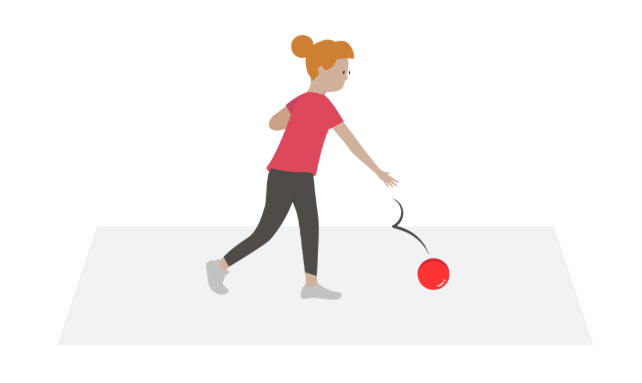
Teaching Points - Bouncing Ball
- Use your fingers, not the palm of your hand, to bounce the ball
- Try to bounce the ball so it stays around waist height
- Keep your eyes on the ball the whole time
- Keep your knees soft with a gentle bend
Teaching Points - Aiming at the hoop
- Keep eyes focused on the centre of the hoop
- Throw the ball with an underarm action for better control
- Throw overarm if further away
- Use enough force so the ball travels into the hoop and bounces
- Follow through with your hand pointing towards the target
Lesson Content
Starter Activity - We're all astronauts
Organisation:
- Split the class into teams of four.
- Each team has one ball.
- Set up planets at the far end of the hall or playing area as per the diagram.
How to Play:
- All pupils are now astronauts trying to hit the planets in the near solar system.
- On the teacher’s signal, the first astronaut from each team throws their ball overarm, aiming to hit a planet cone.
- The goal is to throw long and high, not low and flat.
- If a player hits a planet, they collect it and bring it back to their team’s base.
- After throwing, they collect their ball and hand it to the next player in line.
- Continue until all the planets have been captured or time is up.
Easier: Create the milky way a section in front of the planets made up of hoops that are closer and larger therefore easier to reach.
Look for: Strength and accuracy in throws. Using overarm to throw further. Adapting throw when they miss target. Working cooperatively and taking turns. Encouraging team. Playing by the rules.
Skill Development - Ball bounce exploration
Set-Up: Spread a variety of balls around the space, with one ball available per child. Use different sizes, weights and textures, such as tennis balls, sponge balls, netballs or basketballs.
Start Position: Children begin standing in their own space, away from the equipment.
Activity: On the command “Go”, children choose a ball and begin exploring different ways to bounce it.
Encourage children to try:
- Bounce and catch
- Bounce continuously using one hand
- Swap hands while bouncing
- Bounce low, medium and high
- Try a trick, such as bouncing around the body or under a leg
Change Equipment: After a short time, call “Change”. Children place their ball down safely, move to a new space and choose a different ball to try.
Look for: Eyes watching the ball. Fingers spread ready to contact the ball. Controlled bounces to waist height or lower. Moving feet to keep the ball under control in their space. Staying in own space. Trying different balls and noticing how they feel. Adapting pressure, control and bounce with the different balls.
Activity - 2 vs 1 Bounce and Shoot Game
Set-Up: Place a hoop or marked target area approximately 5 metres from the starting point. Organise children into groups of 3: two attackers (Team 2) and one defender (Player 1). Each group needs one ball.
Team 2 Objective (Attackers):
- Work together to move the ball towards the target area
- Players may bounce the ball to themselves or use a bounce pass to their partner
- Players cannot run while holding the ball, they must stop, pass to hands, bounce pass or bounce to move the ball forward
- Score by bouncing the ball into the hoop or target area
Player 1 Objective (Defender):
- Try to intercept passes or pressure the attackers
- Stay between the attackers and the target where possible
- Work to delay or stop Team 2 from scoring
Game Play: Play short rounds before rotating roles so everyone has a turn attacking and defending. Encourage children to communicate, move into space and control the ball carefully.
Extension: Add a time limit (e.g. 10 seconds) for Team 2 to score. This encourages quicker thinking, faster movement and more urgent teamwork.
Look for: Attackers – Eyes up to spot teammates and space. Controlled bouncing using fingertips. Accurate passes. Moving into space to support a teammate. Shooting at the earliest opportunity. Defender – Staying alert and ready to intercept. On toes to move quickly. Look to catch or knock the ball away. Track one of the attackers to try to mark them. Perseverance when working alone. Optimistic that they can intercept and reduce scoring opportunities.