

PE Throwing Games for Primary School Pupils
Developing throwing and catching skills is a core fundamental movement skill in primary PE. It helps children build coordination, spatial awareness, confidence, and teamwork. Below are some ideas for throwing games in PE that are engaging and suitable for KS1 and KS2.
Throwing and Catching Games – The Basics
Throwing and catching form the essential foundations of ball skills in primary PE. Many sporting activities involve throwing and catching skills. It is important to provide children with ample opportunities to embed the basics and to master throwing and catching. Before introducing more complicated throwing games for primary PE, ensure pupils can:
· Hold and release equipment correctly
· Track objects in the air
· Move feet and body into catching/throwing positions
· Work independently, in pairs and in teams
These fundamentals prepare pupils for all later throwing and catching PE games.
Fun Throw-and-Catch Activities
Here are some examples of simple throwing and catching activities, which are great to give children a chance to practice their throwing and catching skills.
Ball Fun Movement
Equipment: A range of objects that can be thrown and bounced (e.g. tennis balls, basketballs)
How to play:
· Each child has a ball and moves freely around a safe, designated area.
· Teach the children the following instructions
· Bounce & Catch – Bounce the ball once and catch it.
· Swap – Bounce your ball to a nearby player while they bounce theirs to you.
· Dribble 5 – Bounce and catch the ball five times, then continue moving.
Extension: Change the way children travel between commands, such as jogging, side-stepping, or taking big strides.
Check out our free lesson here, which includes this fun game!
On the Move Round the World
Equipment: A range of objects to throw(e.g. beanbags, tennis balls, basketballs)
How to Play:
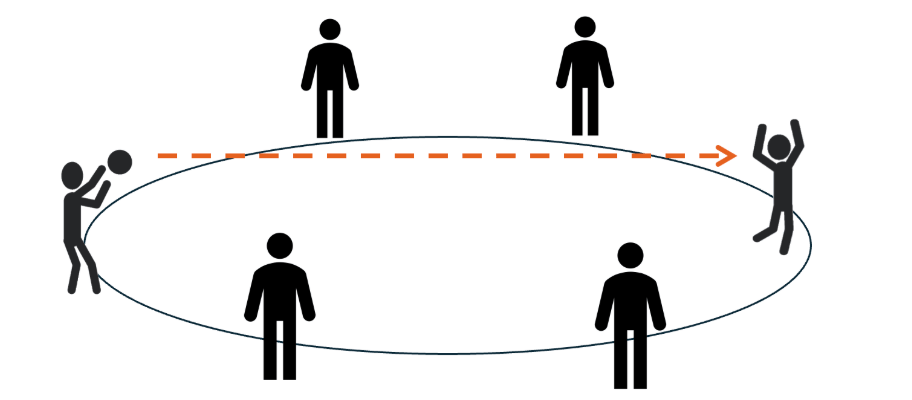
· Children form a circle in groups of around 6.
· Player 1 starts with the ball.
· They can pass to anyone in the circle.
· After making the pass, Player 1 follows their pass and takes the spot of the person they have passed to (Player 2).
· Player 2 then passes to another player and does the same- pass and follow.
· Continue the pattern, keeping the ball moving around the group.
Extension: Make the circle bigger to increase throwing distance.
Check out our free lesson here, which includes this fun game!
Use our free chest pass resource to help children develop their throwing skills in this game.
Engaging Throwing Games
These games are a great way to develop children's throwing and catching skills in a way that is fun and engaging.
Target Ball
Equipment: A range of objects to throw(e.g. beanbags, tennis balls, basketballs), hoops
Set-Up: Create teams of 6, one game per court, with a hoop at each end.
How to Play:
· One player from each team starts in the hoop.
· Others move freely, throwing and catching, but must stop when holding the ball.
· Teams score by throwing to their hoop player, who must catch it.
· Restart after a goal from the centre, alternating turns for the centre pass.
Rotation: After scoring, the thrower swaps with the hoop player.

You can use our free catching the ball resource to help demonstrate the technique for successful catching.
Don’t Drop It!
Equipment: A range of objects to throw (e.g. beanbags, tennis balls, basketballs), hoops
Set-Up: Set up several 5m x 5m square grids and split the class into teams of 6, with a dodgeball.
How to Play:
· Players pass the ball around their team, moving into a space to receive.
· If the ball is dropped, the player freezes and counts to 10 before rejoining.
· Aim for as many clean catches as possible.
Extension: Determine the type of pass, e.g. must be bounce/chest/underarm pass.
Interactive Primary PE Throwing Challenges
Distance Throw Competition
Equipment: A range of objects to throw (e.g. beanbags, tennis balls, basketballs), measuring tapes
Set-Up: Set up a throw line, with a safety zone behind where children who aren’t throwing should wait.
How to Play:
· Children take turns to choose an object to throw from the throw line.
· Once landed, they can measure how far the object was thrown.
· Make sure they measure from where the object landed, rather than where it bounced or rolled to.